REVIEW · PLOVDIV
Plovdiv Old Town Self-Guided Audio Tour
Book on Viator →Operated by Audio Guide Bulgaria · Bookable on Viator
Plovdiv tells its story by foot. This self-guided audio walk links Ottoman-era landmarks to Roman showpieces, without a guide steering you around. I like that it’s designed for your pace, and you can stop, listen, and look longer when something grabs you.
My second favorite part: the Roman Theatre area isn’t just a photo stop. The audio connects what you’re seeing to the bigger city story, so the ruins feel less random. You’ll also pick up lots of context at free sights along the way.
One drawback to plan for: you may need to keep an eye on the on-screen route while the audio plays. If your phone map is hard to read in bright sun or you can’t zoom cleanly, you’ll spend a little time switching screens instead of just wandering.
In This Review
- Key things to know before you start
- Why Plovdiv’s Old Town works so well on an audio route
- Audio guide freedom: pace, timing, and what you actually get
- Starting at the Ancient Stadium of Philippopolis
- Djumaya Mosque and the city’s Ottoman-era imprint
- The Holy Mother of God church site: destruction and rebuilding
- Lamartine House: a symmetrical Old Town pause
- Balabanov House: museum house energy
- Ancient Theatre of Philippopolis: one of the best-preserved Roman theatres
- Ethnographic Museum and the 3-ticket “option” problem
- Nebet Tepe: where Plovdiv’s story starts (4000 BC)
- Hisar Kapia: the medieval Castle Gate
- Small Basilica of Philippopolis: optional indoor/archaeology time
- TrakArt (Cultural Center-Museum TrakArt): mosaics and glass
- Saints Constantine and Helena: ancient temple site logic
- Price and value: is $15.49 worth it here?
- Timing and where you’ll spend your hours
- Who this tour is best for (and who should rethink it)
- Should you book this self-guided Plovdiv audio walk?
- FAQ
- FAQ
- How long is the Plovdiv Old Town self-guided audio tour?
- What language is the audio guide in?
- What is the meeting point for the tour?
- Does the tour end at the same place you start?
- Is the tour private?
- Is there a restaurant discount included?
- Which stops are free to enter?
- Which stops require tickets that are not included?
- What fitness level do I need?
- When can I take the tour?
- Can I cancel for a refund?
Key things to know before you start
- English audio with a mobile ticket: ready to use without hunting for a meeting-time chat.
- A tight loop of major sites: you’ll cover a lot in about 2 to 3 hours on foot.
- Most stops are free to enter: only a few museums require separate tickets.
- Roman and Ottoman layers are both front-and-center: you’ll see how Plovdiv changed over centuries.
- Use the route map smartly: phone glare and zoom limits can slow you down.
- Includes a 15% discount at a city restaurant: a nice perk when you plan a break.
Why Plovdiv’s Old Town works so well on an audio route
Plovdiv is the kind of city where the streets feel like they’re wearing different outfits from different centuries. This audio tour takes advantage of that. You’re not stuck listening to a lecture from a single place. Instead, you’re walking between landmarks that clearly belong to different eras—mosque, churches, Ottoman-era houses, and Roman monuments—so the story keeps moving as you move.
For your practical brain, the format is simple. You start near the Ancient Stadium of Philippopolis, then you work your way through the historic core and end back where you began. The audio is timed so you spend roughly 5 to 15 minutes at each stop, which is helpful if you don’t want to guess how long to linger.
And because it’s private for your group, you aren’t dealing with the “everyone waits for the slowest person” problem. You still control the stop lengths, but the vibe stays calm.
You can also read our reviews of more guided tours in Plovdiv

Audio guide freedom: pace, timing, and what you actually get
This is a mobile, self-guided audio experience in English. You’ll get confirmation at booking, and you’ll use a mobile ticket. That matters because you can plan your start time around your day in Plovdiv rather than around a meeting point with a fixed speaker.
The audio does the heavy lifting: it explains what you’re looking at and why it matters, so you’re not just reading plaques or squinting at stones. For example, you’ll hear about when and how key sites were built, and what happened to them later when rulers changed.
One real-world tip: give yourself a few minutes before the first stop to set up your phone. You’ll likely be using the audio and the route map at the same time. On bright days, screen readability can be an issue, and zooming a PDF-style map can get fuzzy. If you prefer paper, you might want to take your own screenshots of the route points ahead of time—so you can check quickly without interrupting the audio for long.
Starting at the Ancient Stadium of Philippopolis
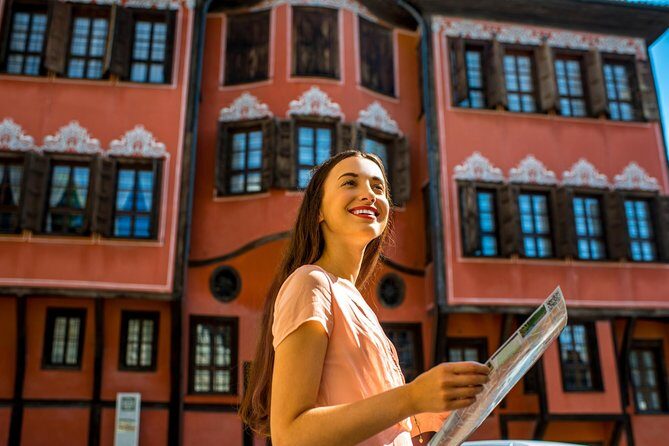
You begin at the Ancient Stadium of Philippopolis in Plovdiv Center, at Staria grad on ul. Hristo G. Danov (4000 Plovdiv). This starting point is a smart choice because it immediately places you in the Roman city layer.
The stadium was built in the 2nd century AD, during the Roman imperial period. Standing near it, you get a sense of how Plovdiv was once a full-on imperial city, not just a medieval town with some Roman leftovers.
From here, the tour starts stepping into later chapters of the city. That’s the bigger point of this route: you’re not only sightseeing. You’re watching Plovdiv’s “era switching” happen block by block.
Djumaya Mosque and the city’s Ottoman-era imprint
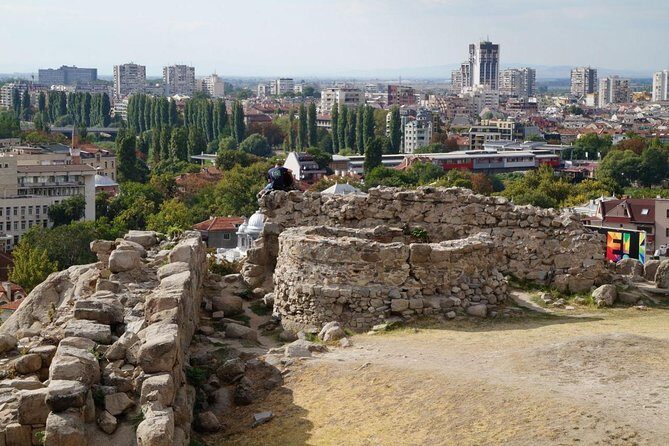
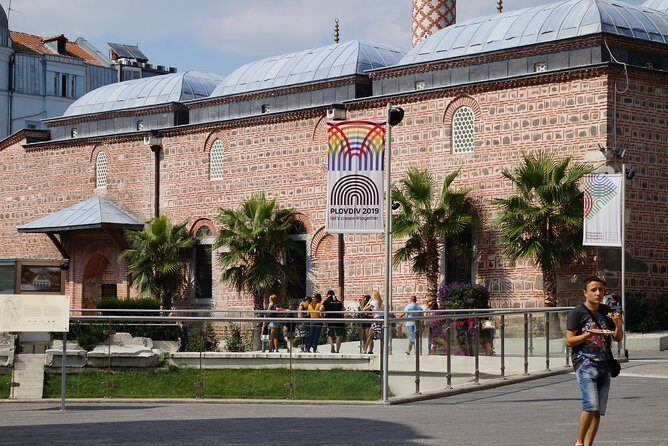
Next up is Djumaya (Jumaya) Mosque. It’s described as a medieval Muslim temple in Plovdiv, with different sources placing its construction under Sultan Murad I (1362–1389) or Murad II (1421–1451). Either way, you’re looking at a site that signals Plovdiv’s Ottoman period clearly.
This stop is short—around 5 minutes—because the audio is focused. You won’t need to spend forever here to get value. The goal is to anchor the Ottoman story early so the later churches and Roman structures have context.
Practical consideration: mosques and religious buildings can have rules about entry and behavior. The good news is the tour assigns it a brief window, so you can keep your visit respectful and efficient without feeling rushed.
The Holy Mother of God church site: destruction and rebuilding
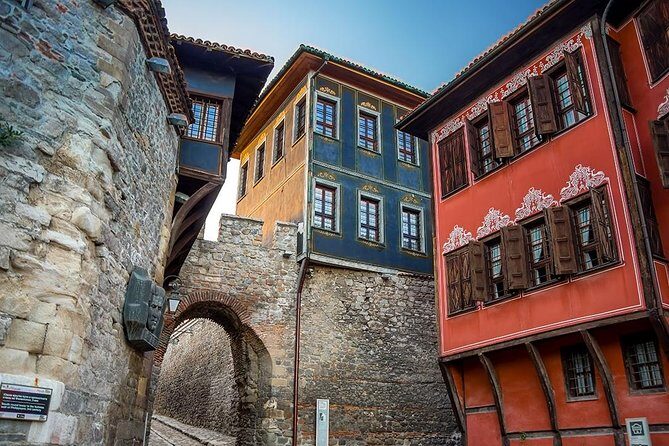
After the mosque, you’ll reach the Church of the Holy Mother of God. This is one of those places where the stones don’t shout, but the dates do.
A church on the site existed as early as the 9th century. It was renovated in 1186 by the bishop of Plovdiv Constantine Pantehi, becoming part of a monastery. Then the audio brings you to the hard turn in the story: both church and monastery were destroyed when the Ottoman Turks conquered the city in 1371 during the Bulgarian–Ottoman wars.
That is exactly why audio works here. Without context, you might see a modest site. With context, it becomes a turning point.


Lamartine House: a symmetrical Old Town pause
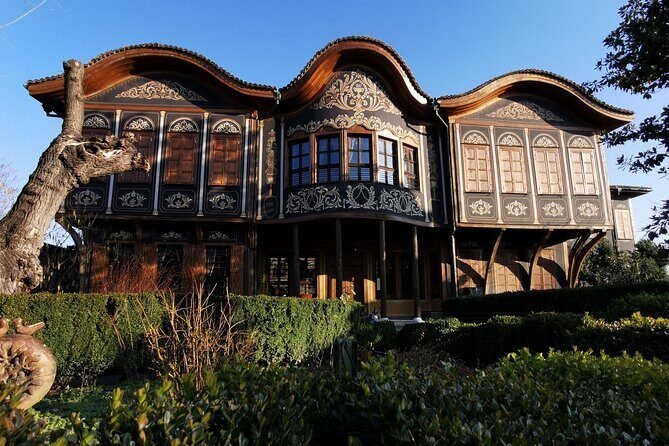
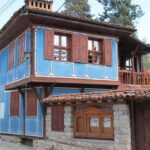
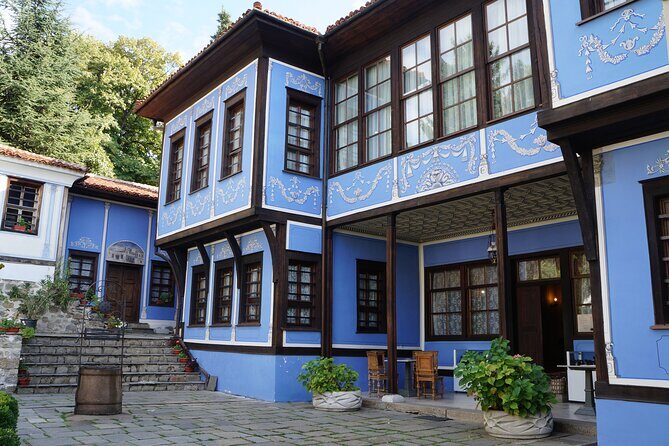
Now you shift from religion and empires into domestic architecture with Casa (Lamartine) House. It was built by an unknown master-builder in 1829–1830, and it’s noted as one of the biggest and most beautiful symmetrical houses in the Old City.
This stop is brief (about 6 minutes), but it’s a useful break. You get a palate-cleanser from temples and ruins, and you also learn how wealthy or influential residents expressed status in the 19th century.
If you like architecture, take a slow moment here. Even in a short time window, you can usually spot the symmetry the description hints at.
Balabanov House: museum house energy
Then comes Balabanov House, also known as the House of Hadji Panayot Lampsha. It’s a museum house built at the beginning of the 19th century.
A stop like this helps prevent “ruins fatigue.” You’re not only looking at ancient stone; you’re seeing how the Old Town kept evolving. The audio tends to frame these houses as part of Plovdiv’s more modern historical layer—still historic, just closer to us in time.
Ancient Theatre of Philippopolis: one of the best-preserved Roman theatres
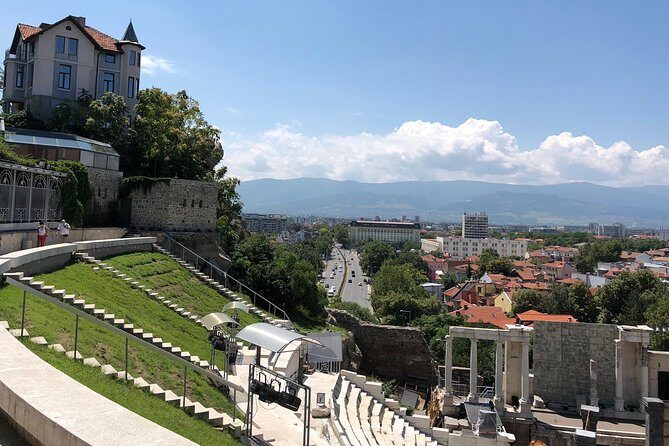
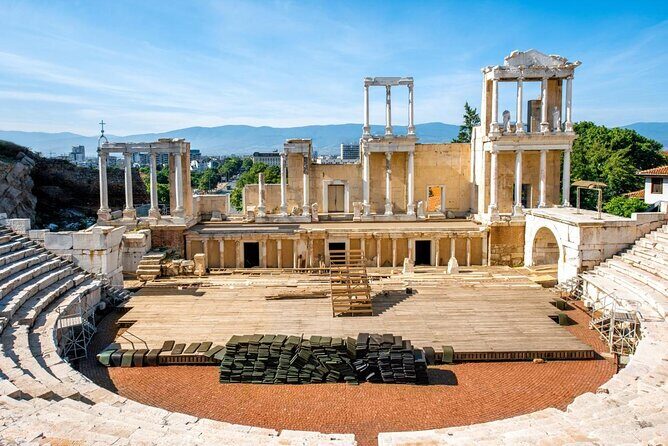
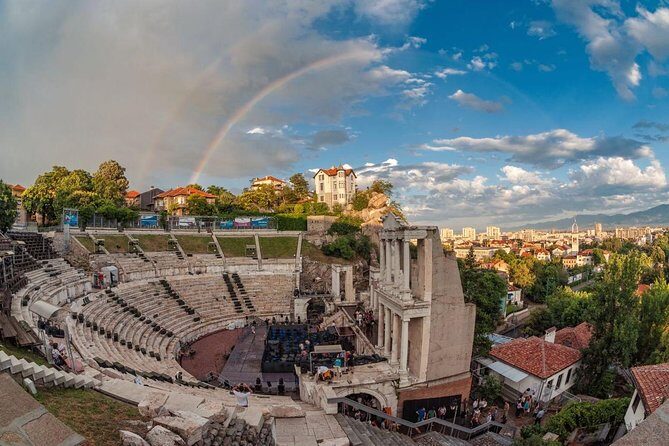
The tour’s Roman showpiece is the Ancient Theatre of Philippopolis. It’s described as one of the world’s best-preserved ancient Roman theatres, located in the city center of modern Plovdiv, once the ancient city of Philippopolis.
The route gives you about 10 minutes here, which is enough to do two things: appreciate the structure and get your bearings for photos and viewpoints. The “best-preserved” part matters because it means you can actually read the theatre’s layout instead of seeing scattered fragments.
Also, the theatre’s location in the middle of the modern city is part of the charm. You’re surrounded by regular streets and daily life while standing in an ancient performance space.
Ethnographic Museum and the 3-ticket “option” problem
After the theatre, you’ll have an option point: Plovdiv Regional Ethnographic Museum. It’s listed as the second largest specialized museum of this type in Bulgaria, with a short stop window of about 5 minutes.
But the key detail is practical: the Ethnographic Museum admission ticket is not included. So this becomes a decision based on your time and your museum budget.
If you’re trying to keep the tour strictly to the “audio-driven route,” you can treat this as a quick glance stop and decide later. If you want more indoor time, you can buy the ticket and extend the visit.
Nebet Tepe: where Plovdiv’s story starts (4000 BC)
Next is Archaelogical Complex Nebet Tepe. Nebet Tepe is one of Plovdiv’s hills where the ancient town was founded. The earliest settlements there are dated back to 4000 BC.
This is one of those spots where you’ll get a quick timeline boost. The audio helps you understand that you’re not just seeing one era—you’re standing near a site that stretches deep into prehistory.
You’re allotted about 15 minutes, which is good because hill sites can take a little extra time for orientation. Even without lingering for long, the context makes the place feel much bigger than it looks at first glance.
Hisar Kapia: the medieval Castle Gate
Then you reach Hisar Kapia, a medieval gate in Plovdiv’s old town. Its Turkish name, Hisar Kapı, is said to mean Castle Gate.
This stop is short (about 5 minutes), but it’s the kind of structure that instantly makes a city feel walled and organized. Gates are where travel routes, defense, and daily movement all meet, and the audio explains the logic behind it as you pass through.
If you like “small but meaningful” details, this is a good one. You don’t need time to read a guidebook chapter; the audio keeps it focused.
Small Basilica of Philippopolis: optional indoor/archaeology time
Now there’s another optional ticket stop: Small Basilica of Philippopolis (5th–6th century). The time window is about 15 minutes, but the admission ticket is not included.
This is worth considering if you want more early Christian architecture and archaeology. If you’d rather keep the tour moving through outdoor highlights, you can skip it and use that time to linger at the Roman theatre or other exterior sites.
TrakArt (Cultural Center-Museum TrakArt): mosaics and glass
The next optional museum is Cultural Center-Museum TrakArt. It’s described as a history museum with several specific exhibitions:
- 160 square metres “in situ” ancient Roman mosaic from the 3rd–4th century
- Glass in ancient art, tracing glass manufacturing from the 5th century BC until the 4th century AD
- Protothracian portrait, with ceramic objects from the eneolith and neolith
- Roman miniature portraits from the 1st century BC up to the 1st century AD
The time window is about 15 minutes, but again, admission ticket is not included.
If you’re the kind of person who likes seeing materials and techniques—mosaic patterns, glass evolution—this is the most “inside-the-thing” of the optional stops. The audio is the best way to get value quickly, because it points you toward what to notice once you’re indoors.
Saints Constantine and Helena: ancient temple site logic
Next comes the Church of St Constantine and Helena. It’s considered among the oldest churches in Plovdiv and was built in 337 at the sight of an ancient pagan temple on one of the fortified hills (the acropolis area).
This stop is about 10 minutes and it’s a great closing act for the religious/imperial thread of the route. You’ll understand the idea of sacred sites re-used over time, which is a big theme in cities with layers like Plovdiv.
Price and value: is $15.49 worth it here?
At $15.49 per person, you’re paying for the audio experience plus the mobile ticket access. The value gets stronger because many stops on the route are listed as admission ticket free. That means your money mainly buys interpretation—clear context and direction—while you’re still able to visit several of the highlights without separate entry fees.
The budget check is simple: only a few stops are ticketed separately (Ethnographic Museum, Small Basilica, and TrakArt). If you plan to skip those three, the tour stays very cost-friendly. If you add them, you’ll pay extra, but you’ll also get more museum time.
For a 2–3 hour walk in a compact Old Town, $15.49 is the kind of price that makes sense when you care about understanding what you’re seeing—not just ticking boxes.
Timing and where you’ll spend your hours
The tour runs about 2 to 3 hours total. That’s a realistic amount of time to cover a lot of landmarks while staying flexible. The stops are short enough that you can keep moving, but long enough that you’re not just reading an audio blurb and walking away.
Also note the operating hours listed for the activity: Monday through Sunday, 9:00 AM to 6:00 PM. In practical terms, that means you can slot it into most daytime plans.
Who this tour is best for (and who should rethink it)
This experience fits best if you like walking at your own pace and you’d rather spend time learning than following a group schedule. It also works well for couples, friends, and anyone who wants a route with structure but not a live guide voice in your ear all day.
You should consider skipping if you’re highly sensitive to screen glare and hate switching between an audio player and a route map. The biggest “friction point” is that you may be reading a phone map while listening.
It also says the experience is for moderate physical fitness. That’s a helpful clue: you’ll be moving through an Old Town with hills involved (Nebet Tepe and the acropolis area), so comfortable walking matters.
Should you book this self-guided Plovdiv audio walk?
I think you should book it if you want the quickest path to understanding Plovdiv’s layers—Ottoman, Roman, and early Christian—without paying for every museum stop. The audio format is strong here because the route keeps changing settings, so the explanations feel useful, not repetitive.
Skip it if you’re planning to rely on tiny on-screen maps in strong daylight and you don’t want any tech hassle during your walk. In that case, you’ll likely spend more energy managing your phone than enjoying the sights.
If you book, do yourself a favor: set up your audio and double-check your route start point near the Ancient Stadium of Philippopolis. Then keep your eyes up. Plovdiv rewards that.
FAQ
FAQ
How long is the Plovdiv Old Town self-guided audio tour?
It lasts about 2 to 3 hours.
What language is the audio guide in?
The audio guide is offered in English.
What is the meeting point for the tour?
The start point is the Ancient Stadium of Philipopolis, Staria grad, Plovdiv Center, on ul. Hristo G. Danov, 4000 Plovdiv, Bulgaria.
Does the tour end at the same place you start?
Yes, it ends back at the meeting point.
Is the tour private?
Yes. Only your group participates.
Is there a restaurant discount included?
Yes. You receive a 15% discount at a city restaurant.
Which stops are free to enter?
Several stops are listed as admission ticket free, including Djumaya Mosque, the Ancient Stadium of Philippopolis, the Church of the Holy Mother of God, Casa Lamartine, Balabanov House, the Ancient Theatre of Philippopolis, Nebet Tepe, Hisar Kapia, and the Church of St Constantine and Helena.
Which stops require tickets that are not included?
Admission tickets are not included for the Ethnographic Museum, the Small Basilica of Philippopolis, and Cultural Center-Museum TrakArt.
What fitness level do I need?
The tour notes a moderate physical fitness level.
When can I take the tour?
The activity is listed with opening hours from Monday to Sunday, 9:00 AM to 6:00 PM.
Can I cancel for a refund?
Free cancellation is available up to 24 hours in advance for a full refund. If you cancel less than 24 hours before the start time, the amount paid will not be refunded.