Sofia packs a shocking amount into the first few hours. This walking tour mixes Old Sofia landmarks with a short tram/metro ride, so you cover real distance without turning the day into a logistics puzzle. You also get a guide in English and plenty of stops where admission is listed as free, which helps you spend more on getting oriented than on tickets.
I especially like the way the route jumps across time periods without feeling random, from a 4th-century church linked to the Council of Serdica to Roman ruins and Ottoman-era architecture. You’ll also get inside visits to places that aren’t just exterior photos. The only catch: each stop is timed (often around 5–15 minutes), so if there’s one site you’d love to linger in, you’ll want to plan extra time after the tour.
In This Review
- Key things to love about this Sofia tour (before you go)
- Getting your bearings in Old Sofia without wearing yourself out
- St. Sofia Church: the 4th-century start that explains why Sofia exists
- Alexander Nevsky Cathedral: Neo-Byzantine scale you can feel even fast
- Kvadrat 500 at the National Gallery: modern Sofia’s art punchline
- National Library and Sofia University: the academic Sofia many visitors skip
- The National Theatre, opera origins, and Largo’s 1950s plan
- Rotunda of St George and Ancient Serdica: where Roman Sofia still breathes
- Mineral Baths, synagogue details, and the West Gate of Serdica
- Zhenski Pazar Market and Banya Bashi Mosque: everyday Sofia in under an hour
- Price and practical value: what $45.66 buys you
- Who this tour suits best (and who should consider something else)
- Should you book this Sofia walking tour with tram ride?
- FAQ
- How long is the Sofia walking tour with tram ride?
- What is the price per person?
- Is the tour offered in English?
- How many people are in the group?
- Do I get transport included?
- Where does the tour start and end?
- Is admission required for the stops?
- What is the cancellation policy?
Key things to love about this Sofia tour (before you go)
- Small-group size (max 10): easier questions and slower decision-making in crowds
- 2 to 3 hours with transit included: you’re not eating up your day with detours
- Free-entry stops are built into the plan: churches, the library/university visits, and major exterior sights
- A mix of Sofia eras: Late Antiquity, Roman streets, Renaissance façades, and Ottoman design
- A practical finish near transit: it ends by Central Market Hall where you can keep moving
Getting your bearings in Old Sofia without wearing yourself out
This is the kind of tour that helps you get your bearings fast. You start in the old city area at St. Sofia Church (ul. Paris 2), then spend about 2 to 3 hours walking and riding transit. The best part for most people: the tour includes the travel time between stops, plus a city transport card and a short tram/metro ride, so you don’t have to figure out routes between scattered big sights.
With English guidance and a small maximum group size, the pace is controlled. The stops are short, but they’re not vague photo-op dashes; they’re structured like a guided route meant for orientation. If you’re the type who likes to understand what you’re seeing rather than just ticking boxes, this format works.
My one practical note: because the tour is short per stop, you should wear comfortable shoes and accept that you’ll get “first look” time, not “sit and study” time. It’s still a great value, but it won’t replace a slower museum day.
You can also read our reviews of more walking tours in Sofia
St. Sofia Church: the 4th-century start that explains why Sofia exists
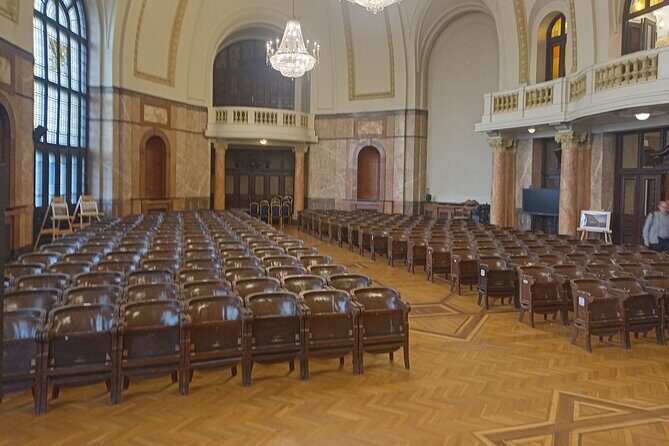
The walk begins at St. Sofia Church, the Church of Holy Wisdom. This is one of the oldest churches in Sofia, dating to the 4th century. What makes it more than an old building is the way it ties Sofia’s identity to earlier history: the predecessor building is linked to the Council of Serdica (held most probably in 343, with 316 bishops attending). And there’s another nice loop-back story—this church helped give its name to the city, which was previously known as Serdika.
What you’ll likely notice on-site is how the church becomes a “time marker.” Standing here first helps everything else on the route make more sense later, because you’re anchored to the city’s deep timeline rather than starting at the modern skyline.
Why I like this first stop: it sets context without requiring you to read a book. A guide can point out the key idea—Sofia wasn’t invented yesterday—and then you’re ready for the rest.
Alexander Nevsky Cathedral: Neo-Byzantine scale you can feel even fast
Next up is St. Alexander Nevski Cathedral, one of Sofia’s most famous religious buildings. It’s Bulgarian Orthodox and built in a Neo-Byzantine style, and it’s listed as one of the 50 largest Christian church buildings by volume in the world.
Even when you’re only there briefly, scale can do that thing that words can’t: it helps you understand why this cathedral became a symbol. If you’ve only seen it in photos, being there in person changes the experience. It also makes a strong contrast with the older St. Sofia Church, even though both are “Holy Wisdom” in spirit—one is about origins, the other is about monumental expression.
Admission is listed as free for this stop, which is a nice bonus if you’re watching your budget.
Kvadrat 500 at the National Gallery: modern Sofia’s art punchline
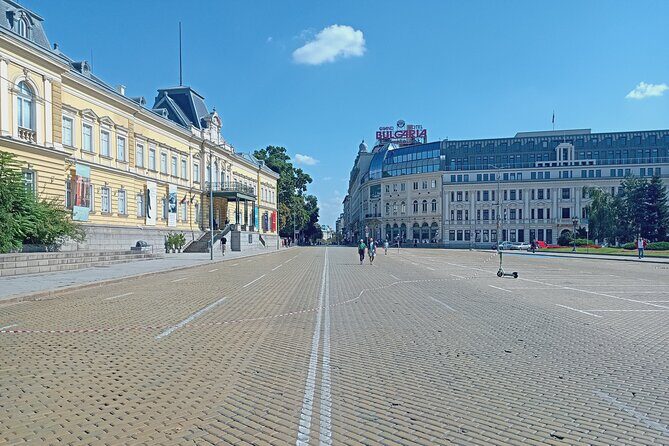
The tour then swings to art at Kvadrat 500, the newest and largest building of the National Gallery, opened 25 May 2015. If you think of Sofia as mostly churches and ruins, this is your reminder that the city also builds contemporary cultural spaces.
Here’s what stands out about the art setup you’ll encounter: about 1,700 artworks from a collection of over 42,000 pieces are exhibited across 28 halls on four levels. The Bulgarian collection traces back to the 1890s, while a large chunk of the foreign collection was formed in the 1980s. That mix matters because it helps you see Bulgaria’s art story as both national and connected to Europe and beyond.
This stop can feel like a breather. The route already gave you deep time; now you get a sense of how Sofia curates art in a modern format. With only limited time, you won’t see everything—but you’ll leave knowing where to return if you want to do a full gallery session later.
National Library and Sofia University: the academic Sofia many visitors skip
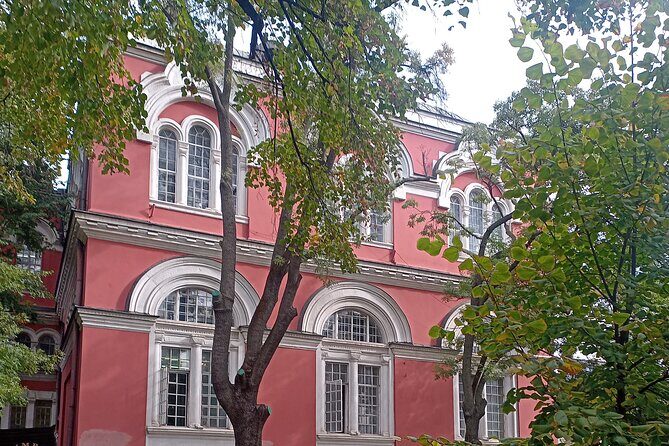
One of the tour’s best “value-per-minute” moves is putting you inside major knowledge institutions. You’ll visit the St. Cyril and St. Methodius National Library, described as Bulgaria’s largest book treasury. It holds nearly 8.5 million documents, and it receives about 70,000 publications each year.
Even if you only get a short visit, this stop changes how you picture Sofia. It’s easy to think of cities as built on monuments, but libraries build a country’s long attention span. It also pairs perfectly with the next stop: Sofia University St. Kliment Ohridski, the first higher educational institution in Bulgaria.
The university’s story stretches back through the country’s broader teaching roots—public teaching activities in Bulgaria are noted as dating to the second half of the 9th century—and the tour frames how the Bulgarian Renaissance sparked the idea of higher education. That context helps you understand the building and the institutions as part of one continuous goal: education as national identity.
You’ll spend about 10 minutes at each of these indoor stops, so it’s a quick visit. If you’re the type who loves quiet spaces and reading rooms, you may want to come back later—just plan it.



The National Theatre, opera origins, and Largo’s 1950s plan
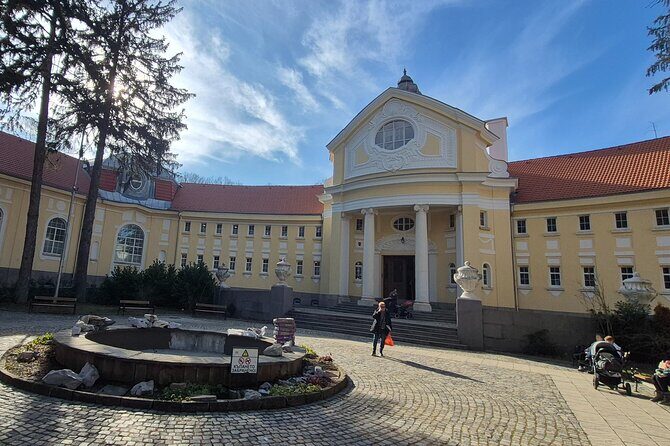
After the university and library, the tour moves into Central Sofia’s “big face” architecture and cultural storylines. You’ll see the neo-Renaissance building constructed 1884–1886, designed by architect Constantin Yovanovic, who studied in Vienna and Switzerland and also designed the Serbian Assembly.
Then comes the cultural timeline that’s easy to miss on your own: in 1890, three Bulgarian musicians—Dragomir Kazakov, Ivan Slavkov, and Angel Bukoreshtliev—organized the first opera troupe in Bulgaria as a branch connected to the Sofia Drama and Opera Troupe. The performances included 12 whole operas and excerpts from 11 operas, with mixed participation and an orchestral setup that included the Guards Orchestra and others. This is the kind of detail that makes the buildings feel lived-in.
The tour also highlights the National Theatre building finished 1906 and opened 3 January 1907. It’s designed by Ferdinand Fellner and Hermann Helmer, famous in the early 20th century, in the Art Nouveau style. The auditorium seating is listed as 848, and the plafond and auditorium walls were painted by artist Rudolf Fuchs from Vienna.
Finally, you’ll reach Largo, a central architectural ensemble of three Socialist Classicism buildings built in the 1950s, designed to become a new representative centre. Largo helps you see that Sofia’s “modern history” isn’t only post-1990; it has its own design era.
This portion is great if you like how a city’s arts and politics leave physical traces. It’s also where the route can feel like “less ancient, more civic,” which is a good change of pace after Roman and Ottoman stops.
Rotunda of St George and Ancient Serdica: where Roman Sofia still breathes
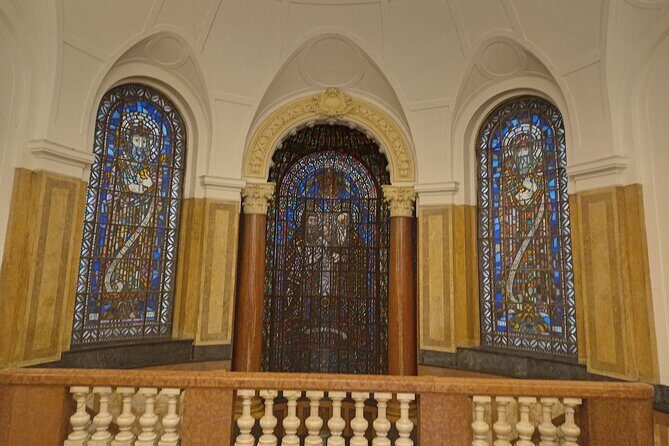
Now you hit the part that turns sightseeing into something you can almost visualize. The Rotunda Church of St George is a late antique red brick rotunda. It began as Roman baths in the early 4th century, then became a church inside the walls of Serdica as the Roman/Byzantine era shifted.
It’s considered the oldest building in modern Sofia and belongs to the Bulgarian Orthodox Church. Even in a short time, the rotunda shape plus the Roman-to-church transformation makes it feel like a portal. It’s a reminder that religions and functions changed, but the stones lasted.
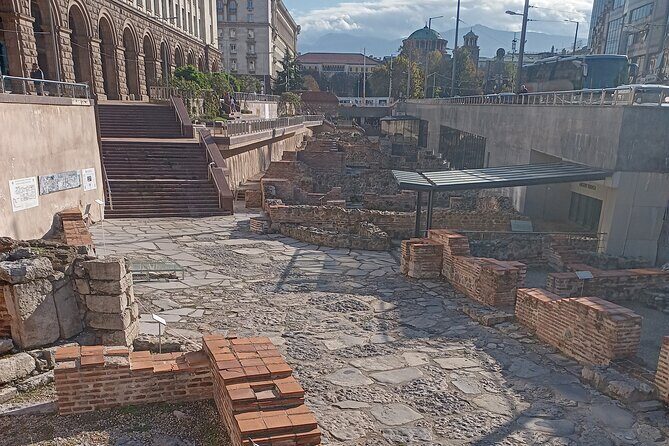
Then you move to the Ancient Serdica Archaeological Complex. This is where the tour’s “walk with meaning” approach really pays off. The complex is divided into two zones, and the Largo zone sits underneath Nezavisimost Square, integrating unearthed remains into a cultural events space.
You can see remains of one of the main streets of Roman Serdica, the decumanus maximus, connecting the eastern and western gates. There’s also mention of a large residential building covering an entire insula with shops. If you like Roman city planning, this is a satisfying stop because it’s not only ruins—it’s a sense of how everyday life worked: streets, homes, and goods.
Admission is listed as free, and the time here is around 15 minutes, which means you get enough to orient your mental map.
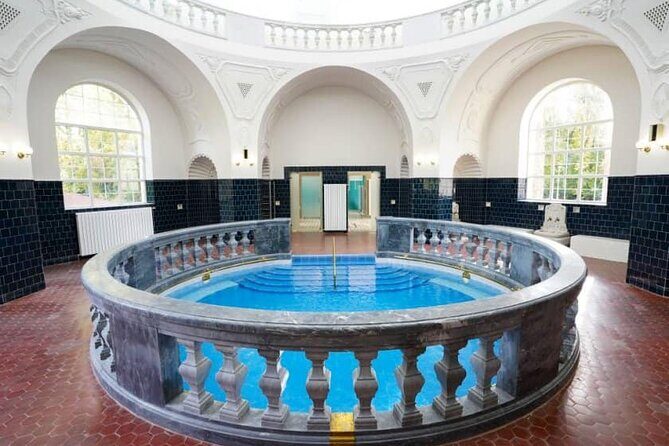
Mineral Baths, synagogue details, and the West Gate of Serdica
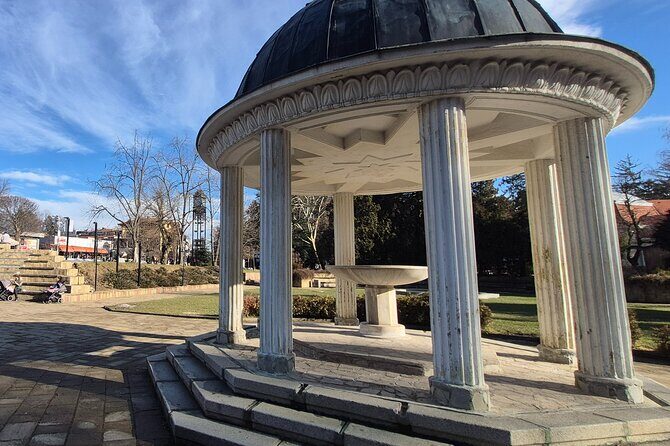
After Roman layers, the tour shifts to Ottoman and early modern Sofia through bath culture and Jewish history.
At Central Mineral Baths (Banski Sq 1), you’ll see a building designed in Vienna Secession style, but with typically Bulgarian, Byzantine, and Eastern Orthodox ornamental elements. Architects are listed as Petko Momchilov and Friedrich Grünanger, and the project dates to 1904–1905, with approval on 30 January 1906. Earlier Vienna/French projects were declined, which is a neat detail: local taste and direction mattered.
Close by, the tour also brings you to the Central Sofia Synagogue. The story here is specific. In the early 20th century, the Jewish community collected donations and invited Viennese architect Friedrich Grünanger to prepare the synagogue project. You can see the names of the 10 top contributors on the wall after entering. Construction took four years, and tombstones from an old Jewish cemetery were used for the base. The value is listed as 437,000 golden leva.
There’s also a location history detail: the synagogue was built on the old site of another synagogue with the Hebrew name Ahava ve Chesed (Love and Goodness). That’s a good example of how the tour teaches you to read buildings as layers, not isolated attractions.
The historical day doesn’t end there. You’ll also see the West Gate of Serdica, protected by towers: a pentagonal tower and a triangular tower near the gate. It’s positioned between St. Joseph Catholic Cathedral, Todor Alexandrov boulevard, and the Monument Symbol of the City of Sofia. This stop helps you connect the ruins with modern streets, which makes the city feel more coherent.
Zhenski Pazar Market and Banya Bashi Mosque: everyday Sofia in under an hour
For a change of mood, you end with market energy and Ottoman-era architecture. The tour includes Zhenski Pazar Women’s Market, noted as the oldest market in Sofia, established more than 140 years ago. It’s described as one of the most important trading centres in the metropolitan area.
Even with a short visit, markets give you something churches and museums can’t: they show how people actually move through a city day-to-day. It’s also one of the easiest places to snack, people-watch, and pick up small gifts.
The tour also connects to Banya Bashi Mosque, built in 1576 during Ottoman military expansion by architect Miamar Sinan. The mosque is near the area of hot mineral springs—Banya Bashi literally ties to baths—and the architect is also credited with major sites like the Selimiye mosque in Edirne and the Suleymaniye mosque in Istanbul (the names are given as part of the description).
If you like a final walk that feels like a lived city instead of a museum list, you’ll probably enjoy this part.
Price and practical value: what $45.66 buys you
At $45.66 per person, this tour is priced like a mid-range guided walking experience, and the value comes from combining several “money-saves” and “time-saves.”
You get:
- An English guide
- A city transport card plus a tram/metro short ride
- A small group cap (max 10)
- Multiple stops with admission listed as free
- Inside visits to places such as the National Library and Sofia University (where short visits still teach you where to look next)
So the cost isn’t just for walking. It’s for getting context quickly across a wide set of landmarks, plus handling transit without you figuring it out mid-day.
The other value point: the average booking lead time is 25 days. That’s a clue that popular times fill faster than you’d think, especially for small groups.
My bottom-line take: if it’s your first time in Sofia (or your first time with a focused route), this price feels fair because it bundles transit, guide time, and free-entry sites.
Who this tour suits best (and who should consider something else)
This is a smart choice if:
- You want an intro to Sofia’s layers—Roman, Byzantine/Orthodox, Ottoman, and modern civic architecture
- You like short, guided stops instead of spending half a day in one museum
- You appreciate a guide who helps you understand what you’re seeing without heavy homework
You might want a different format if:
- You’re hoping for long stays in a single venue. With stop times often around 5–15 minutes, you’ll be moving.
- You want a deep-dive art plan through all 28 halls at Kvadrat 500. This gives you direction, not a full gallery pass.
A quick tip from the tour info: don’t forget sunscreen. Sofia can get sunny, and walking time matters even when stops are short.
Should you book this Sofia walking tour with tram ride?
Yes, you should book it if you want a practical overview that connects major Sofia sights into one coherent story in just a couple of hours. The mix of free-entry stops, indoor visits (library and university), and the included tram/metro ride makes it efficient and good value for the money.
If you’re the kind of traveler who hates wasting time between far-apart attractions, you’ll like this plan. And if you’ve been to Sofia before, it still helps because it focuses on relationships between places—how Sofia’s name, institutions, ruins, and architecture link together.
If you can only spare one guided block and you want to leave with a mental map, this is an easy yes.
FAQ
How long is the Sofia walking tour with tram ride?
It runs about 2 to 3 hours (approx.), including the travel time between stops.
What is the price per person?
The price is $45.66 per person.
Is the tour offered in English?
Yes. The tour is offered in English.
How many people are in the group?
The tour has a maximum of 10 travelers.
Do I get transport included?
Yes. It includes a city transport card and a tram/metro short ride.
Where does the tour start and end?
It starts at St. Sofia Church, Old City Center, ul. Paris 2, 1000 Sofia. It ends near Central Market Hall of Sofia, bul. Knyaginya Maria Luiza 25, level -1.
Is admission required for the stops?
The tour notes admission as free for the listed major stops, including churches and visits like the library and university.
What is the cancellation policy?
You can cancel for a full refund if you cancel at least 24 hours in advance of the experience start time.